
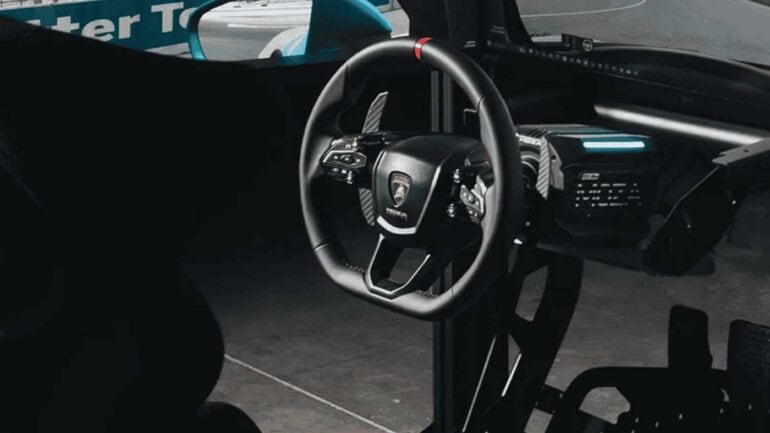

When I was young and Hot Wheels obsessed, I set myself a lofty goal: buy a Lambo beforer I could turn 45. I’m stoked to say that I achieved half of that goal. I turned 45. Fate, it seems, is not without a sense of irony, because through an incredibly well-timed consolation prize, somebody at MOZA Racing has given me a path to experiencing several hundred thousand dollars’ worth of Italian automotive excess via a Lamborghini Revuelto steering wheel for my R12 sim rig. It’s better than nothing. Way better.
This isn’t some vaguely Lamborghini-shaped piece of plastic designed to make my office desk (and beat up Playseat sim cockpit) look fancier than they are. MOZA’s Revuelto Wheel is an officially licensed 1:1 replica of the real McCoy, built using the original CAD data, and it feels every bit as serious as that description suggests. Paired with my MOZA R12 direct-drive wheelbase and the company’s new SRP2 pedals, it also turned my mid-to-high-level racing hobby into something considerably more dangerous to my wallet than I’d initially anticipated.
I’ve spent a good chunk of time with this combination across Assetto Corsa Competizione, Automobilista 2 and modded Assetto Corsa, deliberately picking games that could expose different strengths of the hardware. ACC is the obvious torture test for GT3 cars and high-speed weight transfer, while Automobilista 2 does an excellent job of making changing track conditions and different vehicle types feel alive. Assetto Corsa, meanwhile, provides the opportunity to go hunting for an actual (yet unofficial) community-made Lamborghini road-car mods, including the Revuelto itself, because apparently owning the wheel wasn’t enough and I needed the digital version too.
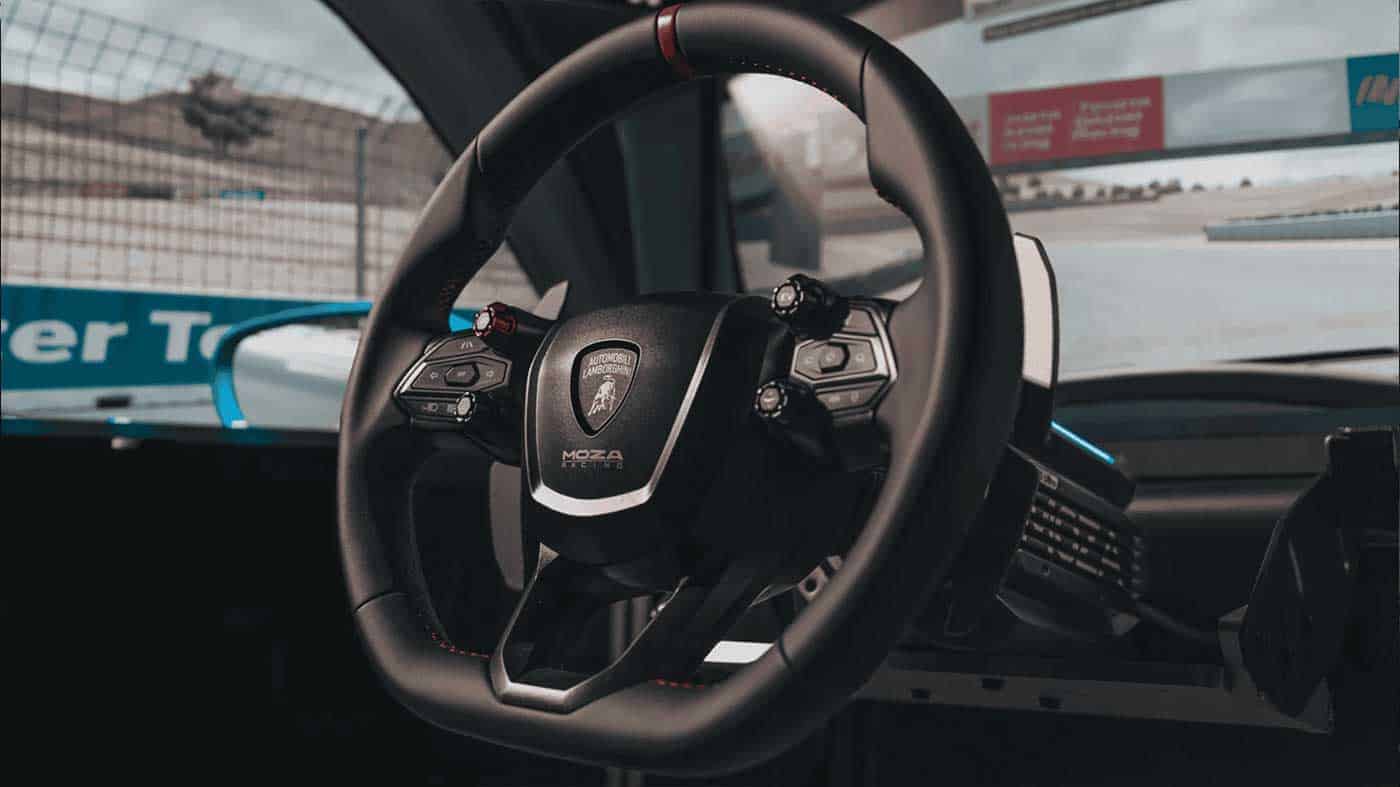
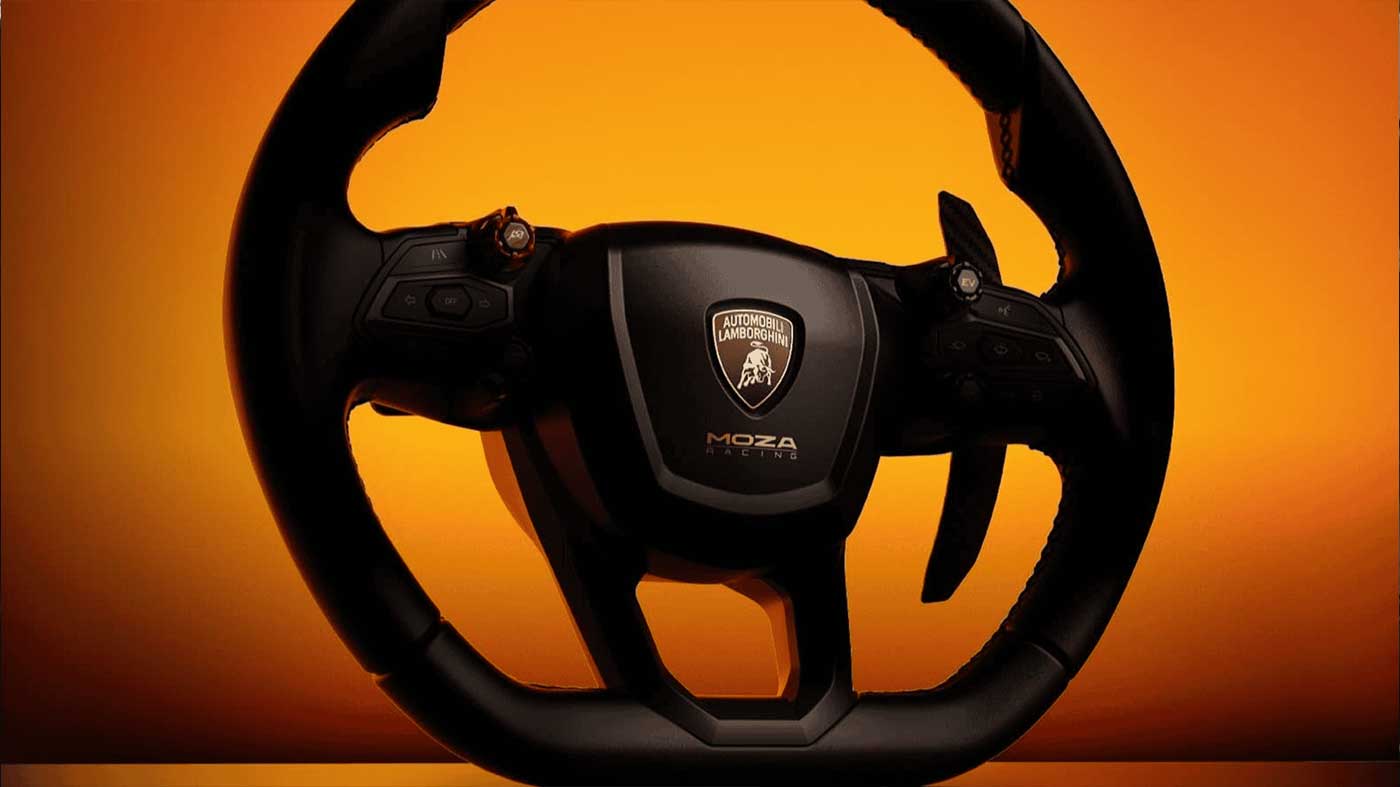
The first thing that strikes you about the Revuelto wheel is its sheer presence. At roughly 330mm to 340mm across, it’s substantially larger than many dedicated GT racing rims, and that D-shaped profile immediately makes your cockpit feel more like a serious automotive simulator than a desk with delusions of grandeur. Again, the proportions and layout are based directly on the real Revuelto wheel, right down to the visual drama that Lamborghini apparently considers an acceptable way to arrange controls.
It’s a gorgeous piece of kit, but the beauty isn’t merely skin deep. The frame is die-cast aluminium, the grips are wrapped in hand-stitched microfiber leather and the overall construction feels properly rigid. There’s no sense that you’re holding a peripheral pretending to be a steering wheel. It feels like a steering wheel that happens to be connected to a computer.
THE CHEAPEST PRICE: $729 WITH FREE SHIPPING FROM JB HI-FI
The Lamborghini branding obviously does some heavy lifting here, but MOZA hasn’t simply slapped a badge onto one of its existing rims and called it a day. The wheel’s shape, switchgear and proportions give it a distinct identity, and the red stitching around the grips adds just enough visual theatre without making the whole thing resemble a gaming accessory purchased from a teenager’s bedroom in 2007.
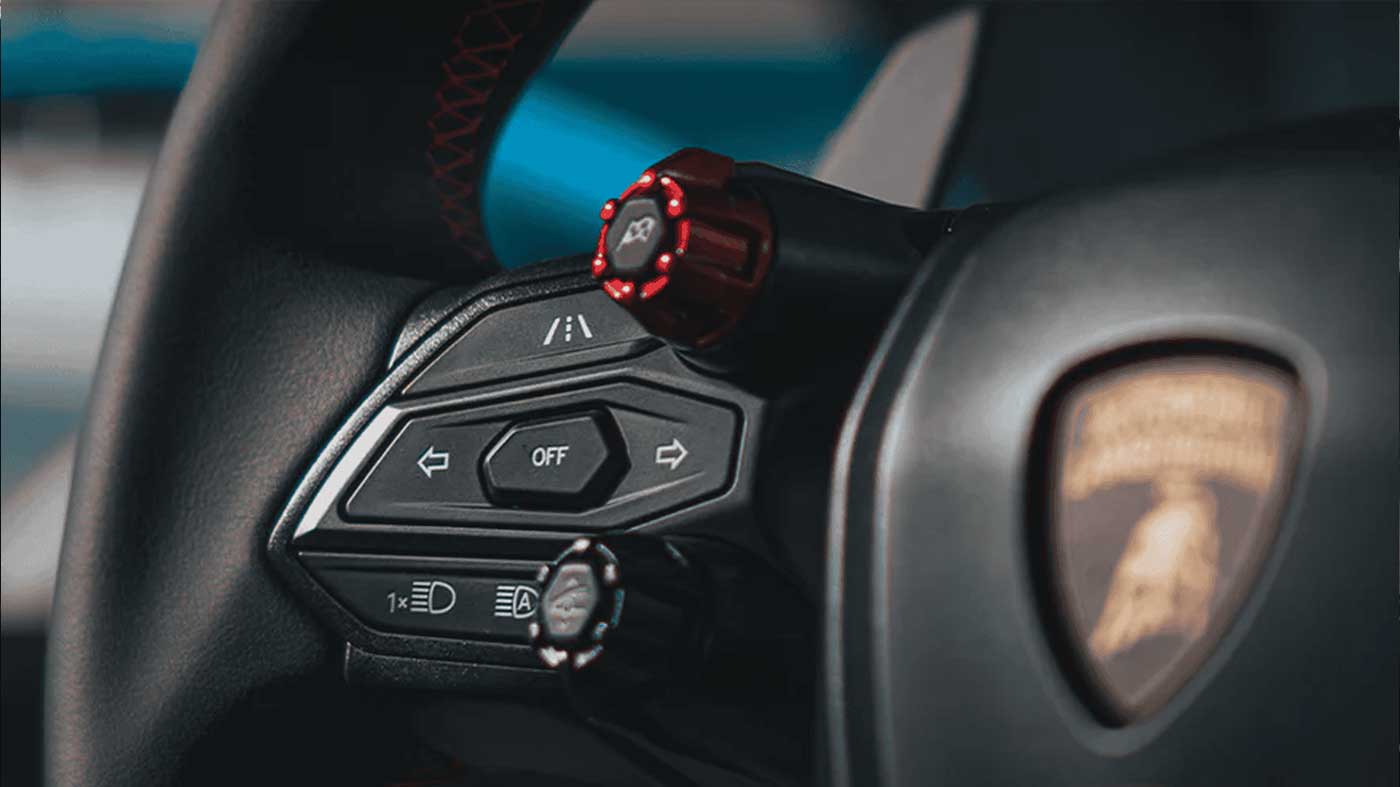
Then you start counting buttons.There are 30+ programmable inputs scattered across the wheel, including 16 backlit buttons on the front, four pushable rotary encoders and ten additional buttons positioned around the rear. There are also carbon-fibre magnetic paddle shifters and dual-clutch paddles, giving you enough control options to configure the thing for just about any racing discipline you can throw at it. I spent considerably longer than I’d care to admit working out where I wanted everything mapped, which is usually a good sign that a peripheral has more utility than its initial novelty value suggests.
The magnetic shifters are particularly good. They’re crisp, immediate and satisfying without requiring an exaggerated amount of force, while the carbon-fibre construction gives them the kind of mechanical theatre you’d expect from something carrying Lamborghini’s name. The dual-clutch paddles also open up some useful launch-control possibilities, although how much you’ll actually use them depends heavily on the cars you’re driving.
Not everything on the front of the wheel feels quite as exotic as the rest. Some of the buttons have relatively short travel and don’t provide quite the tactile feedback I’d expect at this price point, while their proximity to the areas where your hands naturally rest can result in the occasional accidental press when you’re wrestling the wheel through a particularly enthusiastic corner. It’s hardly catastrophic, but when everything else feels so premium, those small compromises stand out.
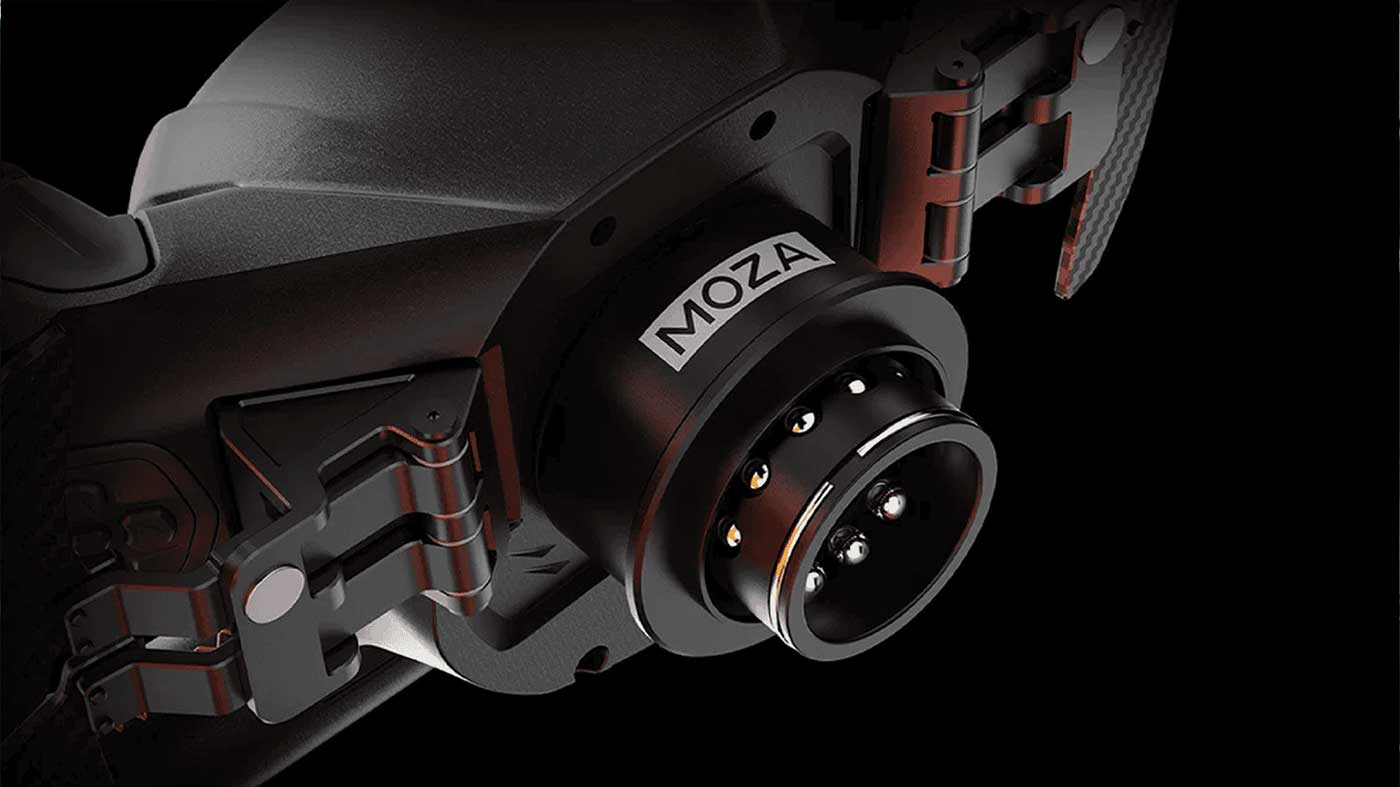
The other obvious consideration is size. The larger rim feels wonderful when you’re making deliberate steering inputs and throwing a road car around, but it also means you’re moving more wheel during rapid direction changes. That’s not a criticism so much as a characteristic of the Revuelto’s design, and it becomes part of the experience rather than something I’d want MOZA to change.
Underneath it all, my trusty R12 direct-drive base (which I’ve been thrashing since mid-2024) did all the heavy lifting. It’s not the focus of today’s discussion, but it would be criminal not to mention what that 12Nm of force feedback does to the Revuelto wheel. The combination gives you a level of instant physical communication that makes cheaper belt-driven systems feel like they’re sending you a postcard from the front axle.
In Assetto Corsa Competizione, that strength becomes particularly useful. The wheel communicates weight transfer, kerbs, changes in surface and the increasingly worrying sensation that you’ve entered a corner considerably faster than your talent permits. The Revuelto rim’s size works beautifully with this kind of driving because there’s enough leverage to make the stronger feedback feel substantial without becoming unpleasant.
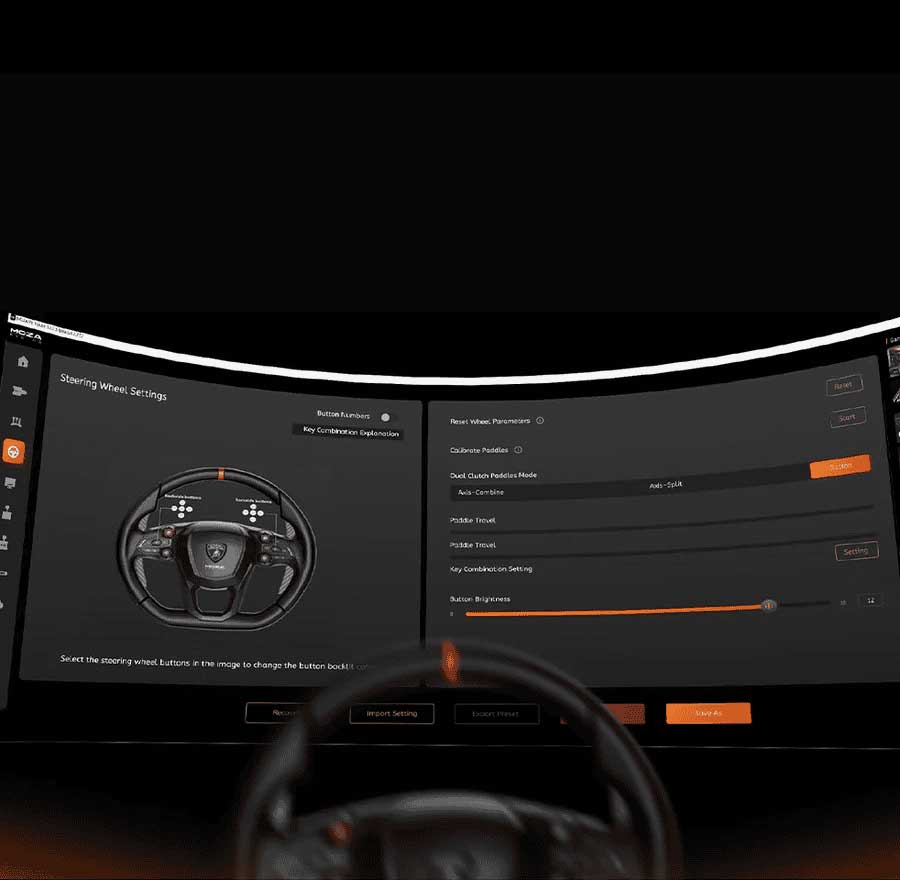
Before doing any serious driving, though, I’d recommend spending time in MOZA Pit House. Calibrating the R12 and getting the damping and filtering where you want them makes a meaningful difference, and it’s worth setting your in-game force feedback gain sensibly rather than simply turning everything to maximum because your new wheel can apparently punch through a brick wall. You want detail, not clipping.
The wheel is the star of the first half of this setup, but the SRP2 pedals are arguably the component that changed my driving more.
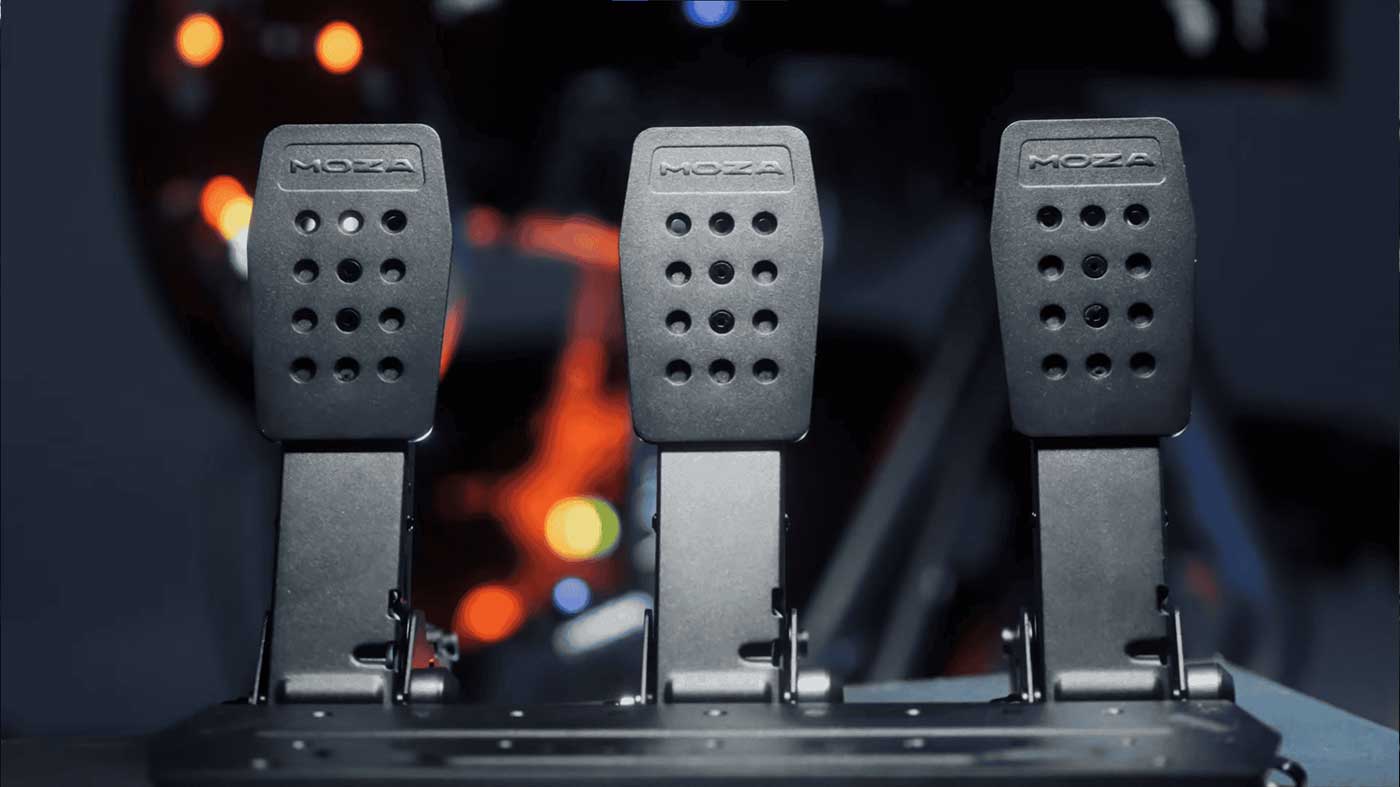
MOZA’s SRP2 pedals use a 100kg load cell brake combined with a 15-bit angle sensor and sensor-fusion technology. In practical terms, that means the brake isn’t primarily interested in how far you’ve pushed it. It’s interested in how much pressure you’re applying. That’s exactly the kind of feedback that makes sense once you’re trying to develop consistent braking points, because your leg is considerably better at remembering pressure than it is at remembering an arbitrary number of millimetres of pedal travel.
This is where my veteran sim-racing lead feet finally become relevant.
The SRP2 brake feels substantially more deliberate than a conventional potentiometer-based pedal. You can lean into it, modulate pressure and progressively trail off as you turn into a corner without feeling like you’re trying to operate a particularly stubborn office stapler. Once your muscle memory starts adapting, the consistency becomes addictive.
The clever part is that MOZA hasn’t treated the load cell as the entire story. The pedal combines it with an angle sensor to control the initial movement before the load cell takes over for heavier braking. That creates a useful progression from initial pedal movement into proper pressure-based braking, rather than making the brake feel like you’ve simply attached a resistance block to the bottom of a lever.
And then there’s the adjustability.
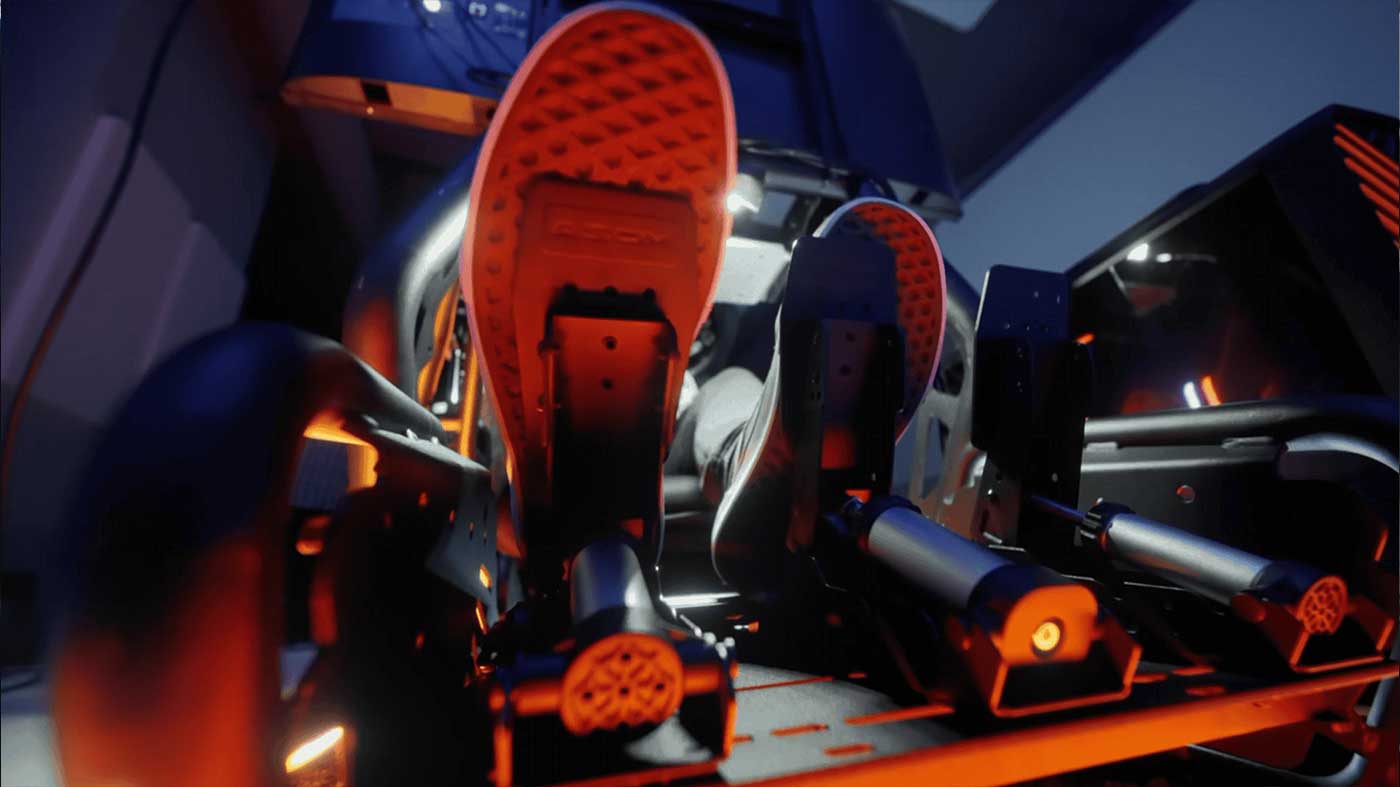
The SRP2 ships with multiple elastomers that provide 25 different brake-feel configurations, while the optional Performance Kit can take that number into frankly silly territory, with more than 1,000 possible combinations. I’ve used the SRP2 Performance Kit alongside the pedals, and this is the sort of thing that can quickly become a dangerous rabbit hole for people who enjoy adjusting their rig almost as much as driving it.
You can alter the pedal face angle, spacing and height, while the throttle and clutch springs can also be adjusted. The pedal faces have 10- and 25-degree tilt options, lateral spacing can move by 15mm either way and there’s 36mm of height adjustment. That might sound excessive until you start trying different seating positions and realise how dramatically a small change can affect your relationship with the pedals.
The optional SRP2 Rear Support Bracket is another accessory I used, and it does exactly what you’d want. It gives the pedal assembly additional support and helps make the whole setup feel more planted, particularly when you’re leaning properly into that 100kg load cell. If you’re building a more permanent cockpit rather than casually throwing the pedals underneath a desk, it’s an accessory that makes a lot of sense.
The physical construction isn’t quite as lavish as the Lamborghini wheel, with pressed-steel pedal faces rather than CNC-machined aluminium, but I don’t think that’s a problem in practice. The pedals are designed to be used, not displayed under museum lighting, and the actual pedal mechanism is where the money matters. There is a little lateral movement under heavy pressure, particularly if you’re actively looking for it, but it never interfered with my driving.
The real test was taking the entire setup across different sims and seeing whether the hardware remained convincing outside its obvious comfort zone. Automobilista 2 was particularly enjoyable because its dynamic conditions and broad range of vehicles allow the R12 and SRP2 to communicate an enormous amount of information. The wheelbase provides the muscle, while the pedals let you translate that information into consistent inputs.
Assetto Corsa Competizione remains the benchmark for this particular setup, though. GT3 cars demand precision, and the combination of the large Revuelto wheel and load-cell braking makes it much easier to develop a sense of how the car is behaving underneath you. You can feel when you’re asking too much of the front end, when the rear starts becoming lively and when you’ve absolutely bottled a braking zone.
I also spent time with the original Assetto Corsa, largely because its modding community makes it possible to get behind the virtual wheel of a Lamborghini Revuelto itself. There’s something deeply satisfying about sitting in front of a real Revuelto replica while driving a digital Revuelto, even if the nearest thing I have to a Lamborghini in real life is the noise my bank account makes when I open the MOZA product page.
That pairing also highlights one of the biggest strengths of this hardware: immersion isn’t just about looking authentic. The Revuelto wheel makes the physical act of steering feel special, while the R12 gives every input genuine physical consequence. The SRP2 pedals then complete the feedback loop by making braking feel like an act of controlling the car rather than simply pressing a button with your foot.
That’s ultimately why I’ve enjoyed this setup as much as I have. Premium sim racing hardware can sometimes become obsessed with specifications, materials and increasingly absurd numbers, but the useful question is much simpler: does it make you want to drive?
The MOZA Lamborghini Revuelto Wheel absolutely does. It’s gorgeous, wonderfully built and packed with more inputs than most people will ever need, while the larger diameter gives it a distinctive feel that suits road and GT-style driving particularly well. The switchgear isn’t perfect and the lack of an integrated display may bother some buyers at this price, but neither issue stopped me wanting to put my hands on it every time I sat down.
The SRP2 pedals are arguably the more consequential upgrade, though. The 100kg load cell, sensor fusion, huge range of physical adjustment and configurable elastomers give you the tools to build a braking setup that actually suits your driving style. The optional spring and rear-support accessories only broaden those possibilities, and unlike some premium peripherals, the benefits aren’t merely cosmetic.
I still don’t own a Lamborghini at 45. Technically, I failed my childhood goal by several hundred thousand dollars and a rather important conversation with my mortgage broker. But after spending hours with the MOZA Lamborghini Revuelto Wheel, R12 and SRP2 pedals, I can at least say I’ve found a remarkably convincing way to experience the sensation of driving one without having to explain a suspiciously large transfer to Lamborghini’s accounting department.
It’s not the same thing, obviously. For one, nobody has yet asked me to stop doing 180km/h through Eau Rouge because the neighbours are complaining.
Still, it’s a bloody good consolation prize. And for a bull that lives in a sim rig rather than a Sant’Agata garage, this beast is very much worth taking the horns of.