



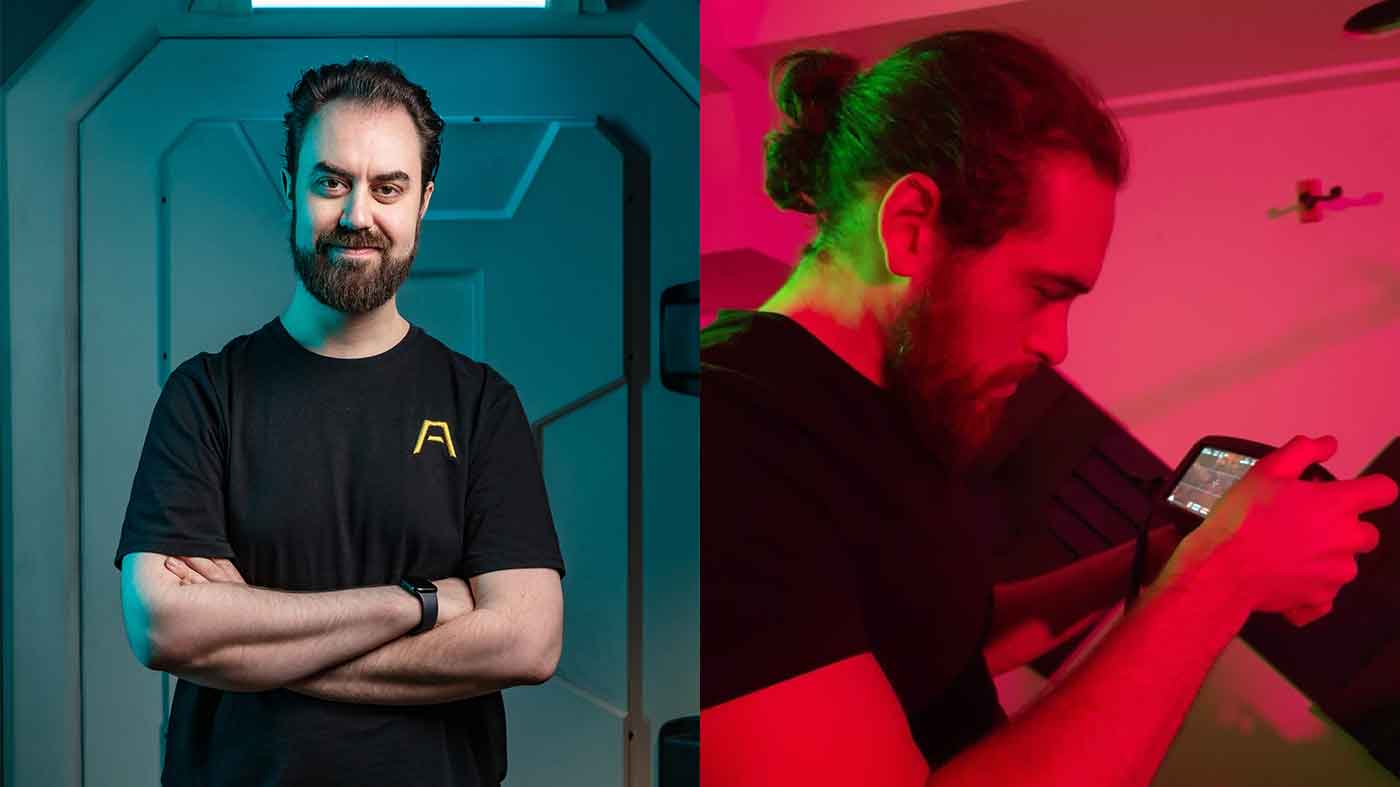
Following our hands-on time with Saros in Japan, we were afforded the opportunity to speak with Gregory Louden, creative director on Saros, and Simone Silvestri, the game’s art director.
We spoke about what kind of friction and difficulty they were hoping to confront players with after Returnal’s punishing grind, how cosmic horror continues to inspire their settings, and how they’re supporting the game on PlayStation 5 Pro.
Louden’s previous credentials, of course, include Returnal, as well as Remedy’s Quantum Break and Control, where he plied his skills in crafting narrative, while Silvestri made the move to Housemarque in 2024 after also holding various roles at Remedy, including lead environmental artist.
From the outside looking in, there are some pretty significant similarities between Returnal and Saros. I noticed, during my time playing the game, that it seems to respect my time a little more, at least from my perspective. Was ease of access and approachability a key focus for the game?
GL: From the outset of Saros, we kind of wanted to build something challenging and rewarding. So, we wanted to keep the challenge of Returnal, but also make every death valuable. It was kind of a critical decision we made earlier in the project that we still wanted to keep the challenge. So, you will die, and I assume you died a few times, Brodie?
Oh yeah.
GL: When you die, you can upgrade yourself using the armor matrix. We wanted to keep you in the action with a second chance, and something you could not check out [during the preview] was the Carcosa Modifiers.
So yeah, it was from the beginning, the wanting to keep a challenge level, but also a rewarding layer.
SS: You know, it’s about understanding what type of friction we want in the game, and we really wanted to keep it on the agility type stuff, not the endurance. We want you to get back into the action as fast as possible and give you those tools to learn how to dance and then be in that eye of the storm.
Did you have data from Returnal that suggested maybe completion rates on that game weren’t necessarily as high as I guess they could have been? And if so, was it having a bit more of a story focus reason enough to reduce the friction to allow players to get through the game?
GL: Yeah, I’d say it more so came from us as developers, where, after developing Returnal, we felt we created something really special, but we also wanted to kind of let it stand on its own. And when we created something new, look at how we could take the best parts of Returnal and then evolve it.
So, early on, we wanted more digestible sessions. One thing we have is the suspend system at launch. Basically, there are all these things that we knew we wanted in the game, and included in that was the more rewarding layer in terms of the story. For us, at Housemarque, we’re gameplay first, but another early decision was that we wanted to have multiple characters. Back when we were developing Returnal, I worked with Harry Kruger, our game director, and he wanted to do multiple characters in Returnal, and I said, “Let’s just do one character well; that’s pretty difficult.”
And since we managed to kind of do that with Returnal, let’s open the cast up. So, it’s kind of a variety of decisions we made early on that we wanted to create a new dark, sci-fi world with Saros that really helped drive the creation of the game in the biggest way.
SS: Yeah. I mean, to me, one of the other points was that we wanted to create more of a sense of journey and more of a sense of an “open world type” feeling. When you get there, and you see that vista, and you now have this geographical way of looking at the world, where you see something in the distance, you’re like, “I’m gonna go there. I’m gonna go and play there later.”
We can reward that now, which is something that I feel is a very good thing to hammer on from Returnal.
I’ve got two directions I’d love to go based on your respective answers, but I’ll tackle character first. Unlike Selene from Returnal, who was voiced by and modelled after two separate people, Rahul Kohli takes care of the whole package that is Arjun Devraj. What was he able to bring to the role? Was he eager to collaborate?
GL: Rahul’s been, honestly, a dream collaborator. He really cares about the character; he really cares about the game. He’s played Saros a whole bunch of times, and, I think, in the best way, he’s really challenged us to make a better character, like he’s brought such authenticity and a sort of realism; we really aligned on the tone we wanted to create.
Every video session, every PCAP session, he’s pushed and really looked at the script, helped improvise, and really helped us create a better game. With regards to gameplay, every time he’s played, he’s had a ton of feedback, which is usually super valid. So, he’s been incredible.
A VO and a QA all in one.
Yeah! He’s amazing. One thing I’d say, which I think he’s shared, which, I think, says a lot about his personality and who he is, is that when we first pitched Saros to Rahul, before we even got to it, he just said: “I’m in. I love Returnal, I love Housemarque. I want to do this game. What am I doing?”
From there, with every collaboration, every meeting since, he’s just wanted to create the best game possible. He even wanted to do his run cycle, so that says how much he really cares and loves games.
And doubling back to Simone’s point about the vistas and seeing things off in the distance; obviously, my hands-on felt rather golden path. What is there in the way of optional content for people who like to go off-road, or is Saros a rather linear experience?
SS: We want to reward forward momentum as much as we can, so we keep the experience very, very tight.
And we try to just really craft these razor-tight arcade combat experiences as much as we can. So there are things that you can find, and the more you progress, the more tools you get to actually do a little bit of exploration. But a lot of what we want from our depth of gameplay is the various narrative layers that you can keep discovering. If you revisit those biomes, you can grab those holo logs, you can grab those notes.
The depth of the combat and the gameplay is that the more you upgrade yourself, the more tools you’re actually going to get to fight. The more you progress, the more tools you have to actually be in that second-to-second experience. Then there are optional parts of the game that even reward hardcore players. You want a bigger challenge? Okay, here you go. There’s something to find in the world, right? So we want that exploration to be on multiple layers.
It’s not just about finding this side path. It’s more about “How do I keep my experience fresh when I am in that combat? And how many more tools can I add to this kit?” So, it’s a lot about rewarding curiosity with depth of gameplay and narrative.
If I’d had more time, I would have loved to go back to the Shattered Ruins to test out the jump pads. I’m looking forward to exploring a bit more. We obviously saw a bit of the World Dial, where I surmised there might be five or six biomes. It might be a “how long is a piece of string?” sort of question, but how long can we expect to spend with Saros?
GL: At this time, we’re still not sharing the amount of biomes or any specifics, because, like Returnal, there’s a lot of mystery and there may be more than you think. But that’s all I’ll say.
Pre-order Saros at Amazon for $99 (includes delivery)
As someone who’s got The King in Yellow on my bookshelf, and as someone who’s seen True Detective’s interpretation, I’m fascinated by where Housemarque’s concept of Carcosa began.
GL: I’d say it began from, as I said, we loved a lot of elements of Returnal, and one thing we specifically wanted to explore more was that of cosmic horror. So starting from there, we kind of went back to the roots of cosmic horror, in the sense that Robert W. Chambers kind of helped envision that.
So, we kind of took it as an inspiration. But from there, we just wanted to create something entirely our own. We went back to the depths of cosmic horror, and you didn’t really get to see a lot of the lengths we go to. That was on purpose for the previews; we took it out of your hands just when it starts to evolve.
Nonetheless, I’d say, it came from us wanting to explore cosmic horror, wanting to tell, once again, a mysterious and haunting narrative while having an ensemble cast to really explore what happens to people on the lost alien planet when there’s a foreboding eclipse that changes them. So I’d say it was just wanting to explore the depths of cosmic horror a bit more.
SS: Working with those brushes is really cool. I love cosmic horror. So, starting from that and then finding other elements to build has been really fun. We have to describe an alien civilization, right? One that is shaped by greed and by the grasping of power and by madness. So, going into those elements is really fun, because you need to start from something that is, you know, maybe a known reference, or something that you can ground yourself in, and then start collecting other points.
And what I like to do, especially, is find things that are very contrasting to that. I love clashes of things. In that visual friction, you always find something interesting to latch onto. We needed to find our own language of cosmic horror and our own language for describing that in the game. I think we succeeded in finding something that is ours, and that gives Carcosa its own identity. It’s this planet that lives by its own identity.
There’s a lot of very striking iconography and symbolism in Saros. There’s a big focus on hands, and, clearly, the sun plays a big role, too. Where did everything sort of start from a creative perspective? Was the idea of an eclipse the jumping-off point?
GL: I’d say it really started from what is the biggest cosmic event, and what’s bigger than an eclipse? Two planets overlapping. So, that was, once again, wanting to explore cosmic horror and really go from there. And then, bit by bit, saying what happens when you stare into the eclipse too long, and what happens when you call the eclipse. Then, as you said, there was various symbolism that we decided to layer in bit by bit.
SS: When I joined, the eclipse was the central theme, and it’s a really cool thing to work with, because it’s so big, massive, and so all-important that you can latch on to it really well. And, of course, it shaped a lot of the symbolism that we wanted. It shaped a lot of the language that we wanted in the world. Then we drew upon various histories of civilizations; there’s been a lot of mysticism towards the sun. And then, from that, we abstracted it a couple of layers, and we started understanding how we want to actually build this civilization.
We looked at various types of architecture. I wanted to have more of a neoclassical feel to it because it’s a place of worship. So, of course, you get these massive temples and statues and arches, but it was a little bit too soft and gentle. So, we actually then made a cross with Italian futurism, which was born as a response to neoclassicism, and as a rebellion to it. So, again, you have this nice clash. And it made these very sharp, vertical lines, very sharp language that added to that violence. And from there, we coined the term “violent beauty,” and that’s how we describe the art direction of Saros. How do we make something beautiful but very, very violent? And that shaped that whole understanding of Carcosa and its inhabitants.
Despite Returnal and Saros being bigger titles for the studio, relatively speaking, it’s clear that your arcade roots are still very much the heart of the team’s focus. How important is it for you guys to maintain that identity, even as you evolve into a AAA studio?
GL: Yeah, I’d say for us, it’s critical. It’s really the fundamental vision of the studio that we’re gameplay first. And we love to create games that are easy to pick up, hard to master, and, if anything, have that show in every new element we’ve added. So, that was actually even a lens for the story back on Returnal. We wanted a story that’s easy to pick up and hard to master with a lot of depth, and that’s the same for Saros.
We pay a lot of attention to detail with our controls. We hope you felt the controls were really tight and responsive. These fundamentals and details drive every decision. So, we really are gameplay first in every way, and the arcade spirit kind of has lived on in us.
SS: It’s really cool to do art direction for a gameplay-first studio. It’s a completely different set of challenges. You have to go into conversations like: “How do we make the art direction of bullets?” And one example of this gameplay-first lens is that I wanted to have lightning come from the bullets, and make them really cool and noisy. Then I showed them to gameplay designers, and they were like, “No, man, I can’t see any of the patterns.” So, we had to restart and then go with a more simplified language.
We had to make this kind of deal where the bullets are really simple from far away, but when they get close, we’re able to add detail, because now you’ve already made your split-second decisions, and now you get to enjoy the art as it’s killing you. But it’s always this type of conversation. “How do I enhance the gameplay?” “How do I get out of the way of gameplay?” One example is with the architecture and all the levels, all of the details are a little bit up. So, if you want really good art, you just have to tilt the camera up a little bit, because in the mid-range that’s a canvas, right? It needs to be quite empty. Then we paint on top of it with the arcade gameplay. So, sometimes it’s about getting out of the way, and sometimes it’s about adding that nice juice to the right parts.
GL: I would also say, thinking a bit more, that even for our storytelling, it’s so much about flow. It’s about keeping in the experience, like the experience of being near an arcade cabinet, you just get lost in the world. So, as well as being gameplay first, it’s about immersion. With the story, we don’t stop you when there’s an audio log; we let you run. Even the holo log, you can stand there. But if you run off, it goes into your earpiece. We’re really always about keeping the player in the action, immersed with the haptics. Every element is really from that arcade sensibility of flow, immersion, and gameplay.
Any plans for PS5 Pro support?
GL: So, our plan is that we’ll be supporting increased base render resolution, and we are supporting PSSR, as well. So it’s been really important for us that players with PlayStation 5 will have a really spectacular experience with Saros. What you played was on a base PS5. I think our amazing team has done tremendous work. I think it looks incredible.
Then, with the Pro, we actually push it even further, so it’s an even clearer image using PSSR. So, if you have a Pro, or even just a base PlayStation 5, it’s awesome, I think. It was important that we didn’t leave anyone behind.