




Despite the rumour mill spinning up and suggesting that Double Fine could be attached to a reboot of Banjo-Kazooie in an attempt to revive that dormant franchise, they’ve instead gone with a different bird-and-other pairing with Keeper, a beautiful little arthouse title about an animate lighthouse and a brightly-plumed shoebill-like bird named Twig. It’s an experiential piece that feels like a big departure from the usual whimsy and comedy they’ve built their house upon. Of course, there’s something inherently goofy about a lighthouse on stilts, trudging through an infected, mountainous landscape with a bird in tow, but Keeper definitely tries to say something and be something bigger than the sum of its parts.

Everyone thought Xbox’s first-party studios would be feverishly pursuing the purple dragon that is the Uncharted-like or the God of War-like. It turns out, all along, they’ve been crafting Keeper, which in many ways is their very own Journey-like, and an undeniable, albeit unexpected, delight.
Keeper doesn’t tell a straightforward story; there’s understandably no dialogue between the lighthouse and Twig whatsoever, though so much is able to be conveyed through gesture and expression. In fact, the decision to frame the lighthouse’s Fresnel lens with a set of iron eyebrows feels like the most inspired decision of them all, because they’re as emotive as Emilia Clarke’s and spell out the story’s emotional beats when words cannot. The game’s themes of friendship and how change can distort or skew worth and the subsequent pursuit of new purpose serve as a beautiful undercurrent to the surface-level pro-environment ideas that see you band together to rid the world of a muck-like scourge called the Wither.

And although we’re led to believe this is a world post-mankind, where only small remnants of community are left, the story itself is structured fascinatingly and goes to some wildly original places that subvert expectation. It’s high-concept, dreamlike, and while I adore the change of pace Keeper boldly adopts in its mid-game, the ending crescendo feels like a damn near religious experience.
Kind of like Howl’s Moving Castle, to draw from another implausibly mobile structure, Keeper’s lighthouse, fortunately, lacks the rigidity of a real-world structure, meaning that Double Fine was able to keep up a nice flow of motion. It bobs and bends this way or that, depending on momentum, almost as if it now has a posture due to breaking apart and being pulled back together during the opening scenes. For a game that’s almost all walking and puzzle-solving, I was nearly put off by the game’s first hour, which, perhaps justifiably, portrays the lighthouse like a fumbling giraffe with unsure footing.

Obviously, this became less of a factor before being flipped on its ear at the game’s halfway point. One thing I simply couldn’t reconcile was the game’s camera, which, due to the player’s control over the lighthouse’s lens, is fixed and not free. For Keeper’s more open areas, which present more frequently in the second half, this became problematic as my view would so often be obscured or facing the wrong way altogether.
Despite this, I found getting around Keeper’s world to be a joy, no matter the form that said travel took. The game’s focus shifts from the game as advertised to more radical ideas in its second half, and so often that the words “game jam” came to mind. While that could sound like a criticism, there’s nothing amateur about Lee Petty’s direction and vision with Keeper.
The problem-solving itself remained rather intuitive and linear throughout, with most of the offerings amounting to fairly rudimentary logic problems. As the game is experiential, and I desired to immerse myself in this wonderful surrealist existence, I didn’t see this as a con, per se. However, it would have been nice to struggle, especially as the late-game “puzzle rooms” became multi-phased. I do applaud the team’s ambition to have the puzzles evolve alongside the gameplay, when it would have been very easy to have the earlier runic dials be a constant throughout.
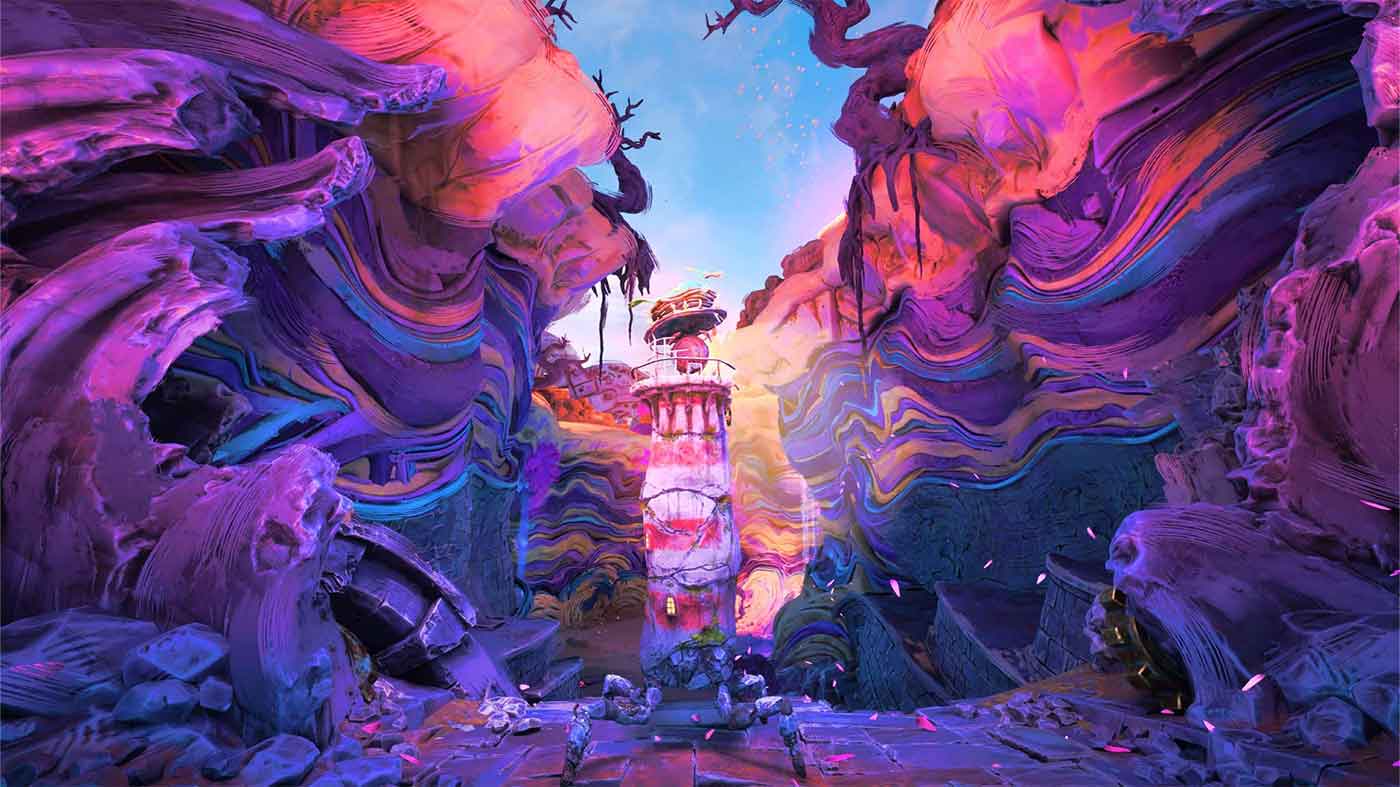
Keeper is an utterly breathtaking audiovisual experience. Its painterly, dreamlike vistas serve as such a memorable canvas for the story they tried to tell here, and the artists’ ability to hop from the literal leftovers of a civilisation, in all its semi-grounded glory, to a world carpeted with cotton candy with titanic creatures soaring overhead, to psychedelic light shows with their distinct, light-bending and prismatic splendour. The ways the artists found to be creative astounded me; even the spires in one area had domes on top that opened out like a Terry’s chocolate orange. Everything is so thought out and considered.
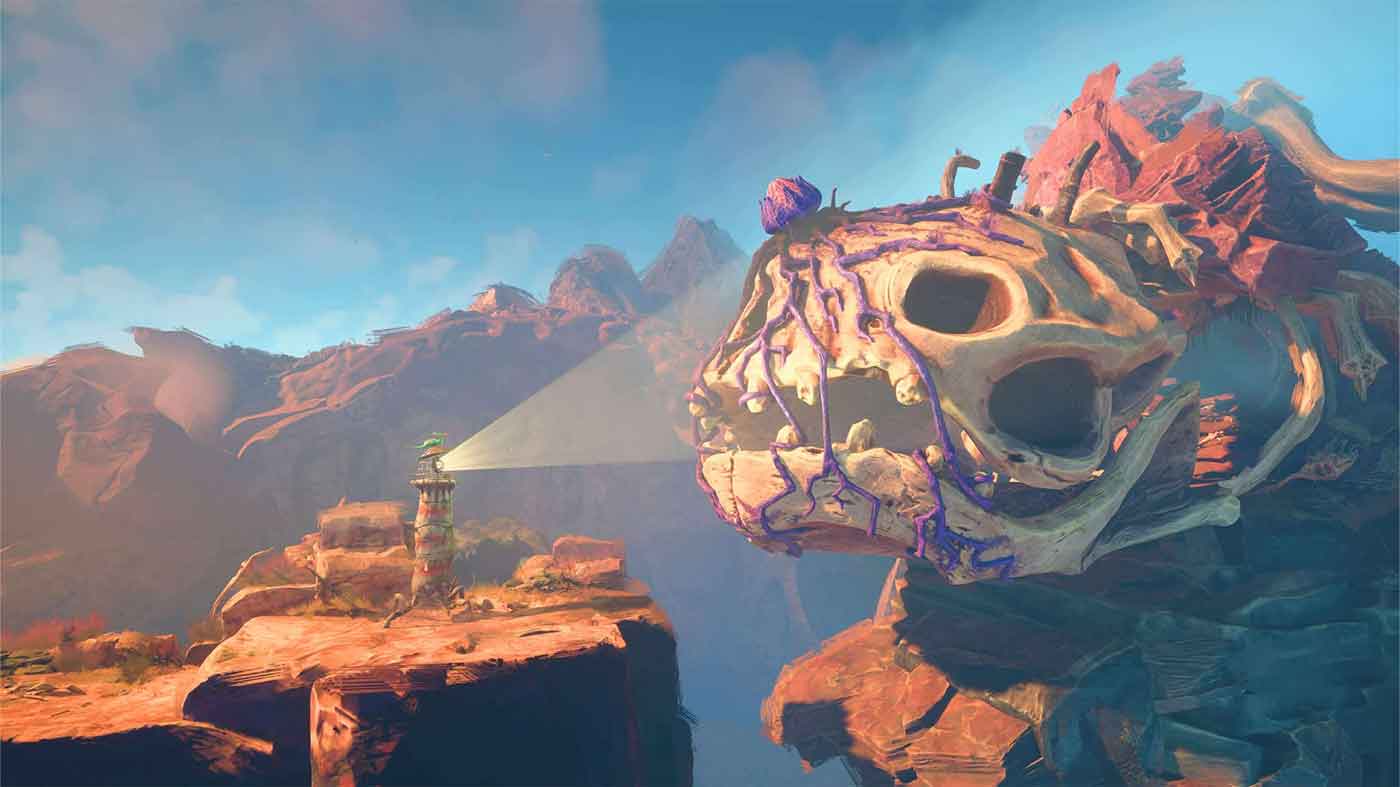
Although Keeper is only a five-hour game, the volume of screenshots I came away with speaks volumes about how picturesque the game truly is. The only ding to the visual credentials would be loss of frames during higher-traffic moments, though I’m sure that’ll be further optimised and ironed out.
Of all the games Double Fine could have made, I’m glad they picked Keeper. I keep coming back to the word ‘unexpected’ and that’s exactly what it is. It’s thought-provoking and evocative, more than any other game they’ve developed, and it’s the most wonderful swing for the fences. Like the lovable lighthouse at the heart of Keeper, this game’s cracks do show; however, the light is so bright that it’s hard to notice.